
USEPA to Establish Coordinating Group on PFAS
On February 6, 2026, the U.S. Environmental Protection Agency (USEPA) announced the creation of a coordinating group to further the federal government’s actions to address PFAS. The group will be led by the Office of the Administrator and the Office of Water and will convene senior technical and policy leaders from USEPA headquarters program offices and regional offices. To improve information sharing, accelerate research and innovation, and strengthen USEPA’s PFAS strategy nationwide, “the [US]EPA will further actions to:
- Regulate new and existing chemicals under the Toxic Substances Control Act (TSCA), requiring companies to provide safety data and limiting harmful uses.
- Set protective drinking water standards under the Safe Drinking Water Act and monitor water supplies nationwide.
- Clean up contaminated sites under Superfund and other environmental laws when contamination exceeds safe levels.
- Control air and water pollution from industrial sources under the Clean Air Act and Clean Water Act.
- Advance cutting-edge research to understand the thousands of PFAS compounds and develop new treatment technologies.”
The U.S. Court of Appeals Issues Order Denying Motions in the PFAS Drinking Water Regulation Litigation
On January 21, 2026, the U.S. Court of Appeals for the District of Columbia Circuit issued an order (USCA Case #24-1188; Document #2155270) denying USEPA’s motion for partial vacatur (Document #2134523). The court found the merits were not sufficiently clear to warrant summary action. The motion would have vacated the maximum contaminant levels (MCLs) for perfluorononanoic acid (PFNA), perfluorohexane sulfonic acid (PFHxS), hexafluoropropylene oxide dimer acid (HFPO-DA), and the hazard index for mixtures of those three, along with perfluorobutane sulfonic acid (PFBS) (referred to as “Index PFAS” by USEPA), while retaining the PFOA and PFOS MCLs.
On February 19, 2026, USEPA filed a separate motion (Document # 2160037) asking the D.C. Circuit to separate challenges to the Index PFAS from the challenges to the PFOS and PFOA MCLs. USEPA’s motion also requested to pause the challenges to the Index PFAS, arguing that a forthcoming rule, which aims to rescind the Index PFAS MCLs, would already negate the pending challenges.
Final case briefings and respondents’ notice are due March 6, 2026.
Oral Arguments Conducted in CERCLA PFAS Rule Case
On January 20, 2026, the U.S. Court of Appeals for the D.C. Circuit heard oral arguments for USCA Case #24-1193, challenging USEPA’s designation of PFOA and PFOS as hazardous substances under Section 102 of the Comprehensive Environmental response, Compensation, and Liability Act (CERCLA). The petitioners’ latest brief states USEPA violated the notice-and-comment requirements, while USEPA’s final brief reinforced that its actions were consistent with the provision of CERCLA that authorizes the designation of hazardous substances that “may present substantial danger to public health or welfare or the environment.”
The U.S. Court of Appeals for the D.C. Circuit has yet to issue an opinion following the January 20 argument.
New Jersey Law Bans PFAS in Food Packaging, Requires Cookware Labels
On January 12, 2026, New Jersey Governor Phil Murphy signed into law Senate Bill 1042, Protecting Against Forever Chemicals Act. Beginning January 12, 2028, the law prohibits the sale of fiber-based food packaging, cosmetics, and new carpets or fabric treatments containing intentionally added PFAS, with an exception for “technically unavoidable trace quantity of” PFAS from impurities or the manufacturing process or where PFAS is limited to electronic or internal components. Additionally, cookware with “intentionally added PFAS in the handle of the product or in any product surface that comes into contact with food” must display a label in English and Spanish stating “this product contains PFAS” and include the same disclosure in online listings. A limited exemption is in place for items too small to carry a label of at least 2 square inches and lack a wrapper or tag.
The act also requires the New Jersey Department of Environmental Protection establish a PFAS source-reduction program by January 12, 2027, and issue annual reports beginning January 12, 2028, for 10 years.
Minnesota Launches PFAS Reporting and Information System for Manufacturers
On January 30, 2026, the Minnesota Pollution Control Agency (MPCA) launched the PFAS Reporting and Information System for Manufacturers (PRISM), an online system for reporting products that contain intentionally added PFAS. PRISM operationalizes Minnesota’s PFAS pollution-prevention statute (“Amara’s Law”) by providing a system for manufacturers (or authorized representatives) to report intentionally added PFAS in products and components sold, offered for sale, or distributed in Minnesota, including online sales. Reports must include a product/category description, PFAS identity and concentration (including allowable ranges), the function of each PFAS, and manufacturer/authorized representative contact information. Information will be made publicly available after MPCA review; however, provisions are in place for trade-secret claims and extension/waiver requests.
Manufacturers must pay a one-time $800 fee per manufacturer and submit an initial report by July 1, 2026. Annual reports are due February 1 each subsequent year.
UK Proposes Thresholds for Four PFAS in Surface Water
OOn January 26, 2026, the United Kingdom (UK) Environment Agency (EA) published a Chief Scientist’s Group report titled Developing Thresholds for Managing PFAS in the Water Environment. The report proposes threshold concentrations for four PFAS in surface waters. In the absence of statutory Environmental Quality Standards (EQSs) for PFAS other than PFOS (0.65 ng/L), the proposed non-regulatory thresholds are intended to support the EA’s assessment and management of risks for additional PFAS commonly reported in UK water bodies. The report relied on toxicological inputs recommended by the European Food Safety Authority in 2020 and followed European Union (EU)EQS derivation guidance to develop threshold criteria for PFOA, PFHxS, PFNA, and PFOS. Bioaccumulation and combined hazardous effects on human health were accounted for by deriving a biota-based threshold of 77 nanograms (sum of four PFAS) per kilogram (wet weight) consumption of fishery products and translating that value into equivalent individual water concentration values. The derived equivalent water concentrations, which are included in the table below, vary markedly based on fish consumption pattern, with some values being below the detection limits currently achievable by commercial laboratories.
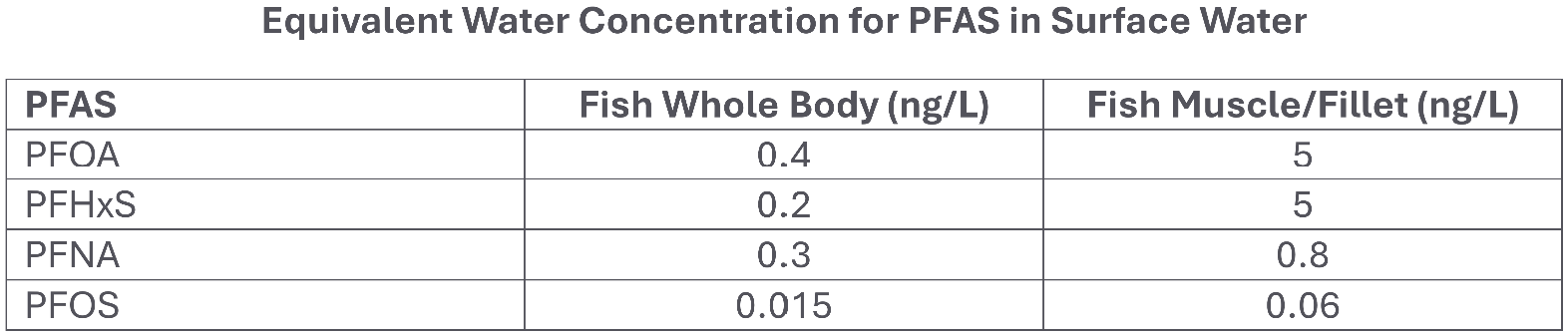
The report also proposed a hazard index (HI) approach to evaluate combined exposure effects. The HI is calculated by summing the hazard quotients for each of the four PFAS. An HI greater than 1 would exceed the biota threshold.
UK Releases Proposed PFAS Action Framework
On February 3, 3036, the UK Department for Environment, Food & Rural Affairs (DEFRA) published a PFAS Plan, which includes PFAS initiatives under the following three strategic pillars:
- Understanding sources (where PFAS are used, how they enter the environment, and risks posed)
- Tackling pathways (supporting alternatives and reducing emissions to air, land, and water from industrial and waste sites)
- Reducing exposure (protecting people and ecosystems, including from legacy pollution)
The plan establishes a framework for future regulatory and non-regulatory PFAS measures and signals a shift toward more consistent and programmatic management of PFAS across sectors and environmental media. It also indicates an intent to align more closely with the EU and global commitments through reform of UK Registration, Evaluation, Authorization and Restriction of Chemicals (UK REACH), including potential tightening of PFAS controls, and a commitment to implement obligations under the UN Stockholm Convention on Persistent Organic Pollutants for PFAS.
Questions?
If you have any questions or would like to discuss how PFAS may impact your business, please email pfas@geosyntec.com to be connected with one of our PFAS technical experts.